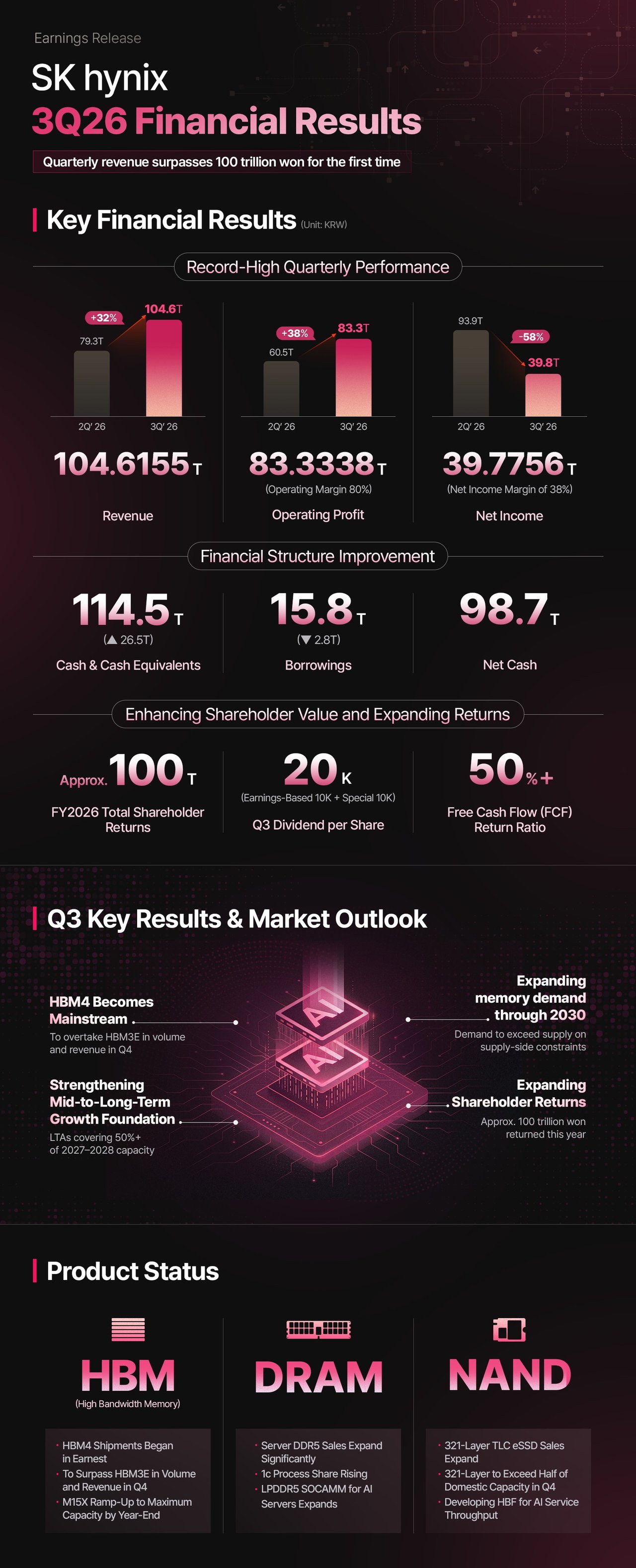
In what underscores the extraordinary strength of the current memory market, SK hynix has reported a record-setting third quarter, marking a milestone in the company’s history and reinforcing its position as a leading force in the global memory industry.
The company announced Q3 revenues of KRW 104.6 trillion, becoming the first time SK hynix has crossed the KRW 100 trillion quarterly revenue threshold. Profitability was equally impressive, with operating profit reaching KRW 83.3 trillion and net profit coming in at KRW 39.8 trillion. Those figures translate into an operating margin of around 80% and a net margin of about 38%, margins that highlight just how favorable current market conditions have been for memory makers.
SK hynix’s balance sheet strengthened further during the quarter. Cash and cash equivalents rose to KRW 114.5 trillion, an increase of KRW 26.5 trillion from the previous quarter. At the same time, borrowings fell to KRW 15.8 trillion, down KRW 2.8 trillion. As a result, net cash climbed to KRW 98.7 trillion, giving the company a strong financial position as it continues to invest in advanced memory technologies.
A major driver of the company’s performance was its high-bandwidth memory business. SK hynix expects HBM4 to surpass HBM3E in both volume and revenue in the coming quarter, making it the mainstream product line in the company’s HBM portfolio. This transition is significant because HBM4 is becoming a key component for next-generation AI servers and high-performance computing platforms, where demand for fast, high-capacity memory continues to grow rapidly.

Meanwhile, SK hynix also reported strong momentum in conventional server memory. Demand for server DDR5 RAM expanded significantly, and the company noted growing uptake of LPDDR5 SOCAMM for AI server applications. Capacity expansion is another important factor in the company’s outlook. Its new M15X fab is expected to reach full production capacity by the end of the year, with output of 55,000 to 60,000 wafers per month of 1b DRAM chips. The company also said that the share of its next-generation 1c DRAM, which underpins its LPDDR6 roadmap, is rising.
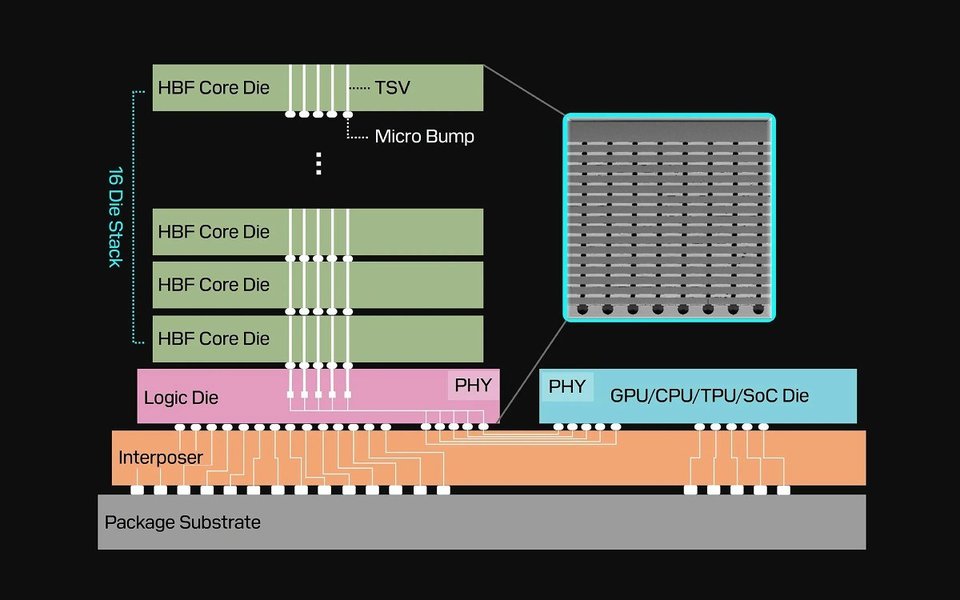
On the NAND flash side, SK hynix said sales of its 321-layer TLC chips for embedded SSDs are increasing. The company expects production of these 321-layer wafers to account for more than half of its domestic production capacity by the end of the year. Beyond standard NAND, SK hynix is also developing High Bandwidth Flash, or HBF, a new technology aimed at AI servers. HBF is designed to function similarly to HBM in terms of architecture, but with a focus on longer-term storage. The idea is to allow AI systems to stream large volumes of data that would otherwise not fit into traditional RAM, supporting more efficient AI inference and training workloads.
One of the most notable takeaways from the company’s financial update was its warning about the memory market outlook. SK hynix said it expects the supply shortage in memory to persist through 2030. Although the company plans to expand production capacity at a faster pace, it emphasized that it will still take time to close the gap between supply and demand. In the near term, enterprise and personal AI applications are expected to drive the bulk of demand. Over the longer term, the company also pointed to growing needs from autonomous driving and robotics as additional demand engines for advanced memory products.
In the broader DRAM market, SK hynix remains one of the top three suppliers. According to a Counterpoint Research report from September, the company was the world’s second-largest DRAM maker by revenue, with a 25% market share. Samsung held the leading position with a 38% share, while Micron came in third at 24%. All three companies are important suppliers of LPDDR and NAND memory to major device makers, including Apple, underscoring how concentrated and strategically critical the memory industry has become.
SK hynix also addressed the cancellation of its plans for a Solidigm IPO. CEO Kwak Noh-Jung explained that the listing had been intended to raise outside capital for expanding Solidigm’s production facilities, reduce the company’s own investment burden, and create more room for shareholder returns. However, he said that after reviewing recent financial market conditions and other relevant factors, the company concluded that proceeding at this time would not be the best way to achieve the original goals. As a result, the company has discontinued its review of the IPO.