AT&T has initiated legal proceedings against T-Mobile concerning the Easy Switch feature within the T-Life app. This tool permits Verizon and AT&T subscribers to log in with their credentials, enabling AI to evaluate their existing plans, lines, and device payments. It then suggests comparable T-Mobile plans while projecting potential savings should users decide to switch.
T-Mobile Argues Against the Likelihood of AT&T's Case Succeeding
AT&T alleges that T-Mobile has breached its Terms of Use (TOU) by copying extensive customer data—over 100 categories—from AT&T subscribers, which AT&T claims could expose users to identity theft and fraud. The telecom giant seeks a court order to halt T-Mobile’s use of the Easy Switch tool and demands deletion of all collected AT&T customer information. Alongside, AT&T requests a temporary restraining order (TRO) to prevent T-Mobile from offering the original Easy Switch to its users.
T-Mobile Maintains No Intention to Reinstate the Previous Easy Switch Version
In a counter-response filed recently, T-Mobile criticized AT&T's motion as “defective.” The company highlights that AT&T customers had already been blocked from using the original Easy Switch even before AT&T filed its motion on November 30. Following AT&T’s restrictions, T-Mobile disabled the Easy Switch for AT&T users. The brief states that, even if the original tool was still accessible, it operates within legal boundaries, making AT&T unlikely to prevail.
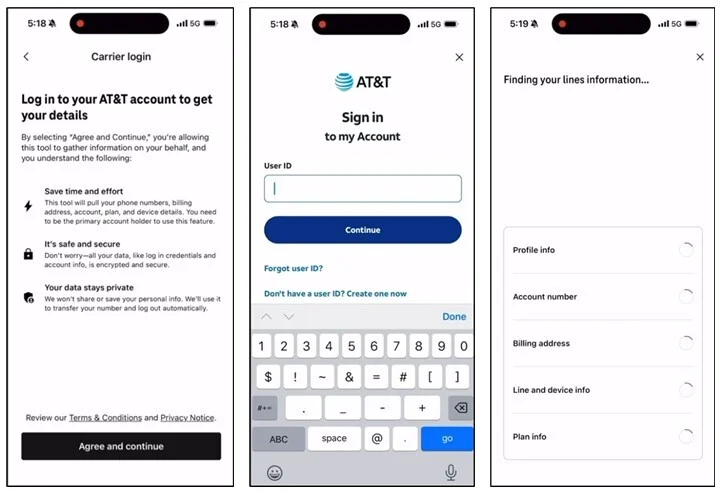
Screenshot illustrating how an AT&T customer shares their account details via the Easy Switch tool. | Image credit: T-Mobile
T-Mobile reiterates that it has no plans to revert to the original Easy Switch version, asserting that “the conduct AT&T is challenging is not ongoing and there is nothing to enjoin.” The company also points out the contradiction in AT&T's claims, emphasizing that this dispute indeed revolves around competition. T-Mobile argues that AT&T essentially wishes to restrict how its subscribers voluntarily share their own account information to compare wireless providers.
Public Opinion Poll
Current results: No – 75%, Yes – 0%, It's a close call – 25% (4 votes)
T-Mobile’s Legal Position and Evidence Presented
In its brief, T-Mobile urges the Court to deny AT&T’s request, stating that AT&T fails to meet the necessary criteria for temporary injunctive relief. To support this, T-Mobile presented screenshots showing AT&T customers actively logging into their own accounts to share data with the Easy Switch tool. Importantly, no data was transferred to T-Mobile unless it had already appeared on the customer's device. Thus, AT&T subscribers should expect their plan information to be utilized in this manner when voluntarily sharing it.
T-Mobile also challenges AT&T’s claims about excessive traffic impacting its infrastructure. According to T-Mobile, only 342 AT&T customers have used Easy Switch thus far, a minuscule number compared to AT&T’s 119 million subscribers. This weakens AT&T’s assertion that the tool could force costly infrastructure investments.
What T-Mobile Requests from the Court
The brief concludes by emphasizing that since T-Mobile has already disabled the allegedly unlawful version of Easy Switch and has no plans to reactivate it, AT&T cannot prove it is suffering or will suffer irreparable harm. Without such harm, there is no basis for temporary restraining relief, allowing the Court to dismiss AT&T’s motion promptly.