Yesterday, Huawei unveiled its new Mate 80 series smartphones along with the Mate X7 foldable device. Notably, four of the five models feature the recently introduced Kirin 9030 series chipsets. The lineup consists of two versions of the system-on-chip (SoC): the standard Kirin 9030, found in select Mate 80 Pro variants, and the Kirin 9030 Pro, reserved for the Mate 80 Pro (16/512GB), Mate 80 Pro Max, Mate 80 RS Ultimate, and Mate X7.
While Huawei has yet to release full specifications for these new chips, Weibo users have shared screenshots of the Mate 80 models revealing key hardware distinctions between the two versions.
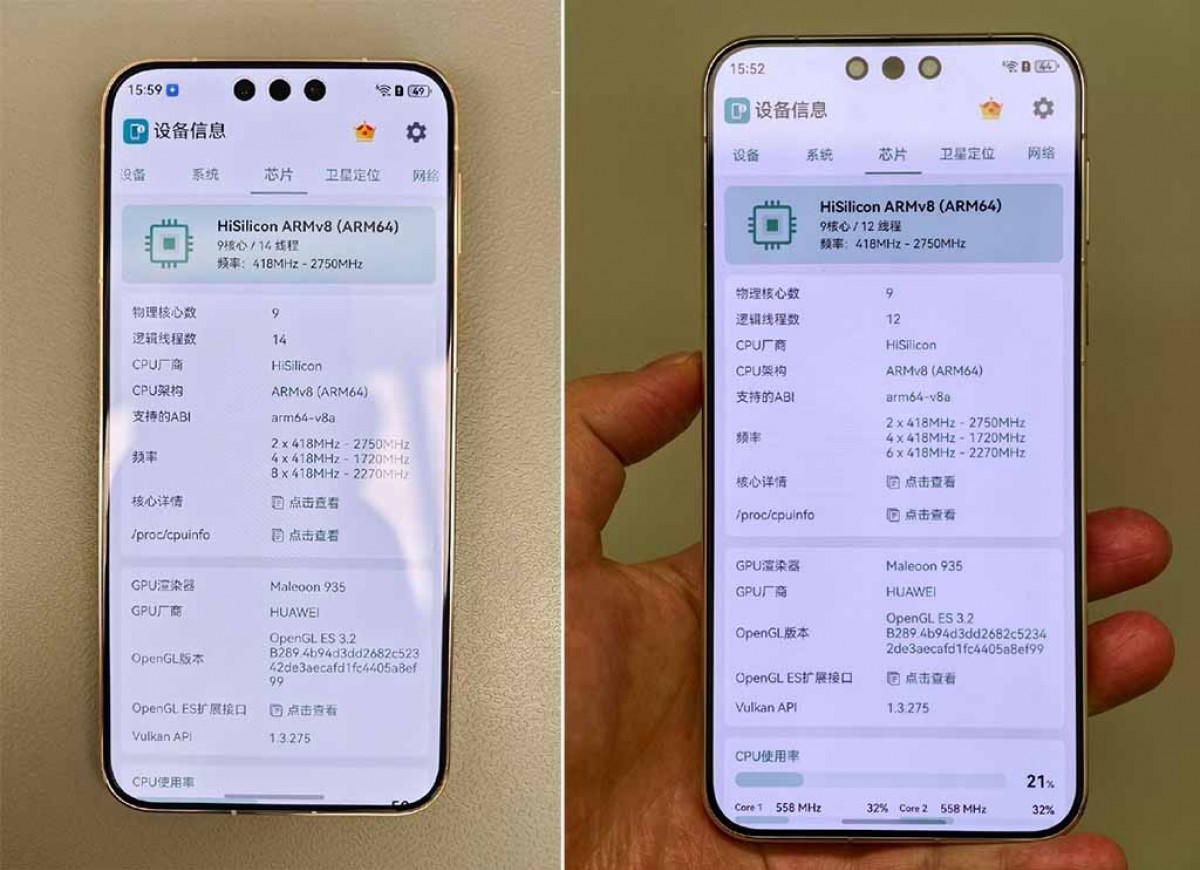 Kirin 9030 Pro (left) vs Kirin 9030 (right)
The Kirin 9030 Pro features a 9-core CPU architecture with 14 threads. According to the screenshots, its prime cores run at 2.75GHz, performance cores at 2.27GHz, and efficiency cores at 1.72GHz.
In contrast, the Kirin 9030 has an 8-core CPU with 12 threads. Both chipsets share identical clock speeds, utilize the same ARMv8 CPU cores, and are equipped with the Mali-G77 MP11 GPU. The primary difference is the absence of one performance core in the Kirin 9030.
Rumors suggest the Kirin 9030 series is manufactured using SMIC’s N+3 process node, a 6nm technology also employed in the Kirin 9100 chipset powering the Mate 70 series. More official details about the Kirin 9030 chips are expected to be released soon.