Huawei has launched its latest application processor (AP), the Kirin 9030 Pro, which will power the new Huawei Mate 80 Pro Max. This chip is notably the first commercial SoC manufactured by SMIC using its cutting-edge N+3 process node — a technology delivering performance on par with 5nm chips from competitors.
SMIC Employs Multi-Patterning with DUV Lithography to Overcome EUV Restrictions
Due to restrictions preventing SMIC from acquiring extreme ultraviolet (EUV) lithography machines from ASML, the foundry relies on deep ultraviolet (DUV) lithography combined with multi-patterning techniques. Unlike EUV, which requires a single exposure at a 13.5nm wavelength, DUV processes operate at a longer 193nm wavelength. To achieve the fine circuitry features necessary, SMIC must carry out multiple printing and etching cycles — sometimes up to four passes — on each wafer.
This multi-patterning approach, while innovative, increases complexity and can introduce alignment challenges. Consequently, this leads to higher failure rates during quality control, reducing wafer yields and driving up costs. It also results in longer production times compared to EUV-based processes.
For context, EUV machines use a single light exposure with a wavelength of 13.5nm to print circuit lines, whereas SMIC’s DUV systems use 193nm UV light, necessitating the multi-patterning strategy for Kirin 9030 Pro’s production.
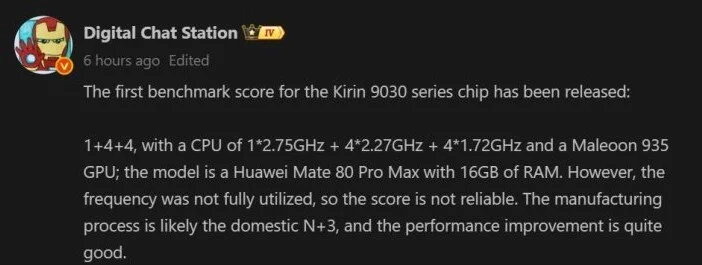
A Weibo post by reliable leakster Digital Chat Station reveals the Kirin 9030 Pro AP sports a total of nine CPU cores configured as follows:
- 1 high-performance CPU core clocked up to 2.75GHz
- 4 mid-performance CPU cores up to 2.27GHz
- 4 energy-efficient CPU cores up to 1.72GHz
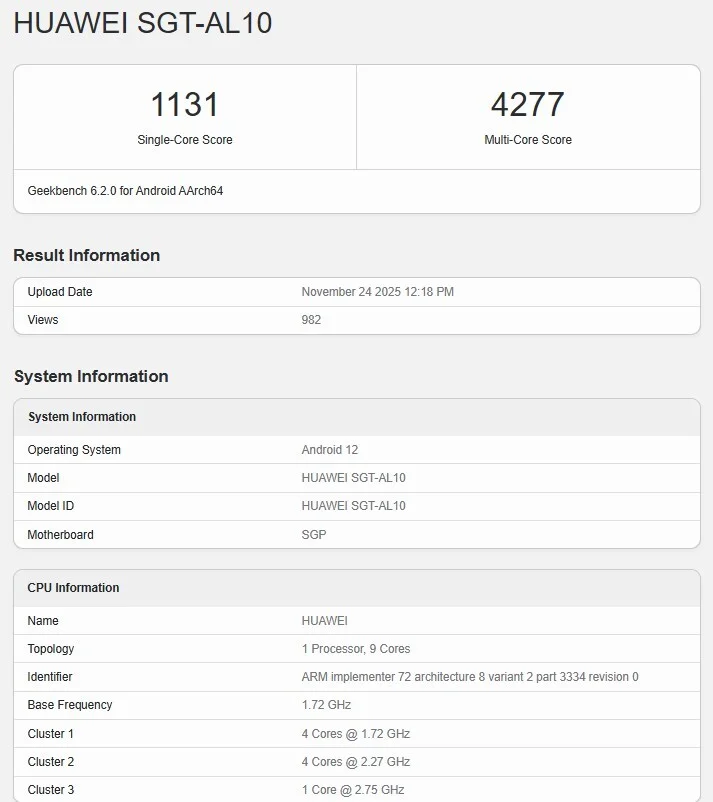
The chipset integrates the Maleoon 935 GPU, an upgrade over the Maleoon 920 GPU featured in last year’s Kirin 9020 AP. However, benchmark results for the Kirin 9030 Pro on the Huawei Mate 80 Pro Max with 16GB RAM show modest performance, with a single-core Geekbench score of 1131 and a multi-core score of 4277.
By comparison, here is how the Kirin 9030 Pro’s performance stacks against three leading rivals:
Snapdragon 8 Elite Gen 5
- 320.9% faster single-core score (3,629 points)
- 245.2% faster multi-core score (10,488 points)
Dimensity 9500
- 300.1% faster single-core score (3,394 points)
- 233.2% faster multi-core score (9,974 points)
Another competitor (CPU & GPU unspecified)
- 346.6% faster single-core score (3,920 points)
- 234.1% faster multi-core score (10,011 points)
Despite these figures, Digital Chat Station cautions enthusiasts to interpret the Kirin 9030 Pro’s scores carefully, as Huawei has previously been known to exaggerate chip performance. Nonetheless, the main challenge remains the inability of SMIC to utilize EUV lithography, which significantly impacts Huawei’s chip competitiveness.
It’s also worth noting that SMIC previously manufactured Kirin APs starting with the Kirin 9000 series used in 2023’s Mate 60 Pro using its 7nm N+7 process node. In contrast, the Kirin 9030 Pro is SMIC’s first commercial chip built on the more advanced N+3 process.
Two Variants of the Kirin 9030 Series
There are two models within the Kirin 9030 lineup:
- The Kirin 9030 Pro, powering the Mate 80 RS Ultimate Design and the higher-storage Mate 80 Pro versions (typically with 16GB RAM). This Pro version supports 14 threads via Simultaneous Multithreading (SMT).
- The standard Kirin 9030, targeting lower-storage Mate 80 Pro models with 12GB RAM. It supports 12 threads.
Both variants contain nine CPU cores, with some cores enabling SMT to handle multiple tasks simultaneously. The Pro variant’s additional threads contribute to a slightly improved multi-core performance over the standard chip. The base Mate 80 model continues to use last year’s Kirin 9020 AP produced on SMIC’s N+7 process node.