Electric vehicle (EV) batteries are known to be expensive, but just how costly are they? More importantly, what does the cost structure of an average EV battery look like? These are questions that the team at Elements by Visual Capitalist aimed to answer. They created a clear and informative infographic detailed below.
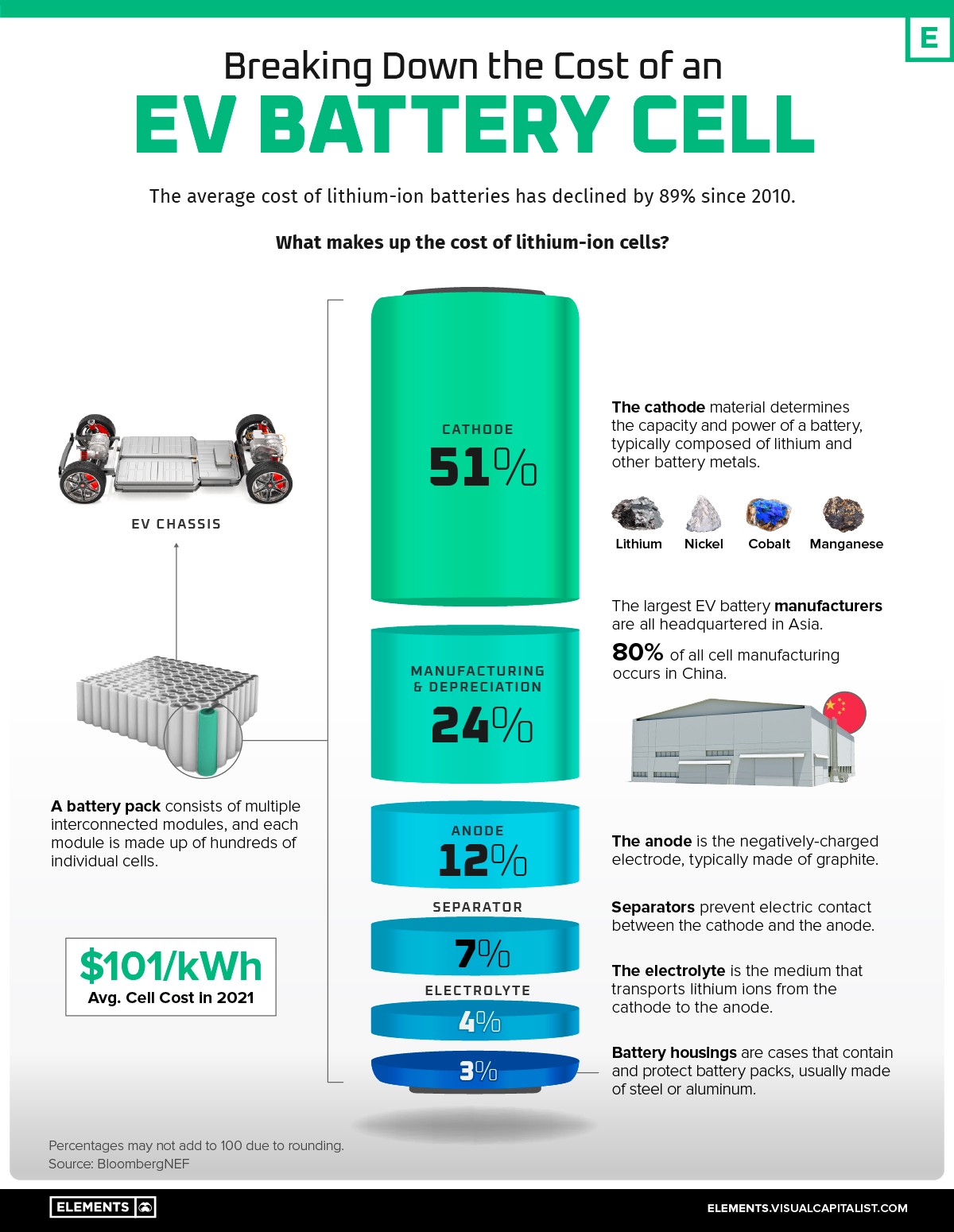
In 2023, the average cost of battery cells stood at $101 per kWh. When considering the full battery pack, the cost rose to $132 per kWh. This means you can easily estimate the battery cost for any EV by multiplying its gross battery capacity (in kWh) by $132. While $132/kWh may still seem high, it represents a dramatic decrease from $1,200 per kWh in 2010.
The infographic highlights that the most expensive battery component is the cathode. This positively charged electrode plays a critical role by storing electrons and positively charged ions when the battery discharges, releasing them again during charging.
The cathode’s importance explains its high cost as it fundamentally influences the battery’s performance, driving range, and thermal safety. Cathode compositions vary depending on cell chemistry, commonly including lithium iron phosphate (LFP), lithium nickel manganese cobalt (NMC), and lithium nickel cobalt aluminum oxide (NCA). The metals used in cathodes are highly valuable, representing about 40% of the total cell cost.
The remaining 49% of cell cost is attributed to components other than the cathode, with manufacturing accounting for a significant 24%. Another key part is the anode, contributing around 12% of the cost. Typically, anodes in lithium-ion cells are made from natural or synthetic graphite, which is considerably less expensive than the metals in the cathode.
Source