FCC Seeks Public Feedback on Proposed Rule to End Deceptive Overseas Robocalls
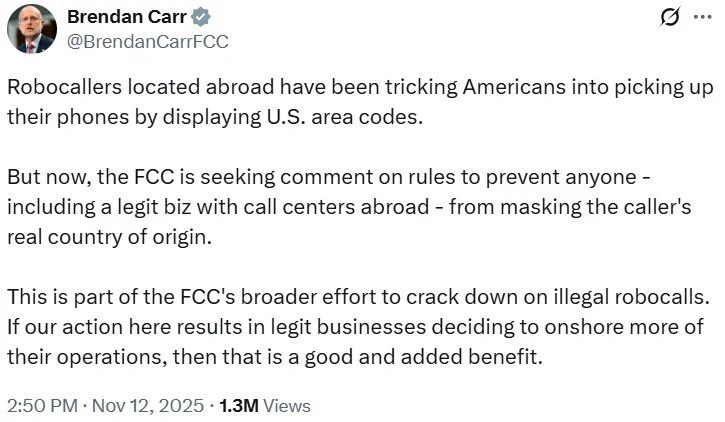
FCC Chairman Brendan Carr recently highlighted the growing issue of robocallers based outside the U.S. who trick consumers by displaying U.S. area codes. In a recent tweet, Carr emphasized the need for new FCC regulations that would stop callers from “masking” the true origin of their phone calls. These proposed rules aim to improve consumer protection while also accommodating legitimate businesses that utilize overseas call centers.
Public Opinion on the FCC’s Proposed Action
Chairman Carr further explained, “This proposal is a key element in the FCC's wider campaign to curtail illegal robocalls. If the new rules encourage legitimate businesses to move more operations to the U.S., that will be an added positive outcome.” Encouraging onshoring could bolster the U.S. economy by creating more jobs—albeit often lower-wage positions—while simultaneously enhancing American consumers’ safety.
Under the FCC’s proposal, calls originating outside the U.S. must display verifiable geographic information, explicitly revealing the country from which the call is made. This measure addresses a critical need: last year, U.S. consumers received approximately 4.2 billion robocalls, with a significant number originating abroad. These intrusive calls often facilitate scams, such as fake tech support schemes or fraudulent IRS debt threats, disproportionately targeting vulnerable senior citizens.
45-Day Public Comment Period and Expected Timeline
The FCC has opened a 45-day comment period inviting input from telecommunications providers, affected businesses, consumer advocacy groups, and the general public. The earliest possible vote on the rule is expected next spring. Following approval, implementation could be phased over 18 months, enabling wireless providers to upgrade their networks to comply.
The FCC remains vigilant in countering overseas scammers who exploit international call centers to defraud Americans. Public response to Chairman Carr’s announcement shows widespread frustration with such schemes. Besides regulatory action, both iOS and Android devices offer built-in features to reduce scam and spam calls before they reach consumers.
How Smartphones Help Block Spam and Scam Calls Differently
iOS devices use a contact-prioritization system, allowing users to enable features such as “Silence Unknown Callers” found under Settings > Phone > Screen Unknown Callers. Android devices, especially those running the Google Phone app, emphasize AI-powered spam identification sourced from large databases.
Android users can follow these steps to activate spam call prevention:
- Open the Google Phone app.
- Tap the menu icon next to the search bar.
- Select “Caller ID & spam” and turn on the toggle.
For Pixel users, additional protections like “Scam Detection” and “Call Screen” can be enabled to automatically identify and manage suspicious calls.
With combined FCC efforts and advanced phone features, U.S. consumers may soon feel more protected against the persistent nuisance of scam and spam calls.