OpenAI is grappling with a shortage of GPU (Graphics Processing Units) chips, causing delays in the anticipated rollout of its latest model, GPT-4.5. GPUs are crucial for training advanced AI models due to their ability to perform simultaneous data processing, which is essential for complex computations and large-scale data handling. Unlike CPUs (Central Processing Units) that operate sequentially, GPUs are uniquely suited for the matrix operations prevalent in artificial intelligence.
In a recent tweet, OpenAI's CEO Sam Altman assured users that a significant influx of GPU chips is on the way—hundreds of thousands are expected soon, and he anticipates a quick utilization of these resources. Currently, the new model is exclusively available to subscribers of ChatGPT's Pro version at $200 per month. However, once OpenAI replenishes its GPU stocks, even ChatGPT Plus users, who pay $20 per month, will gain access to GPT-4.5.
The quest for additional GPUs isn't as simple as a trip to a local store; OpenAI is also exploring the development of its own semiconductor technology to mitigate its dependence on the volatile inventory levels from companies like NVIDIA.
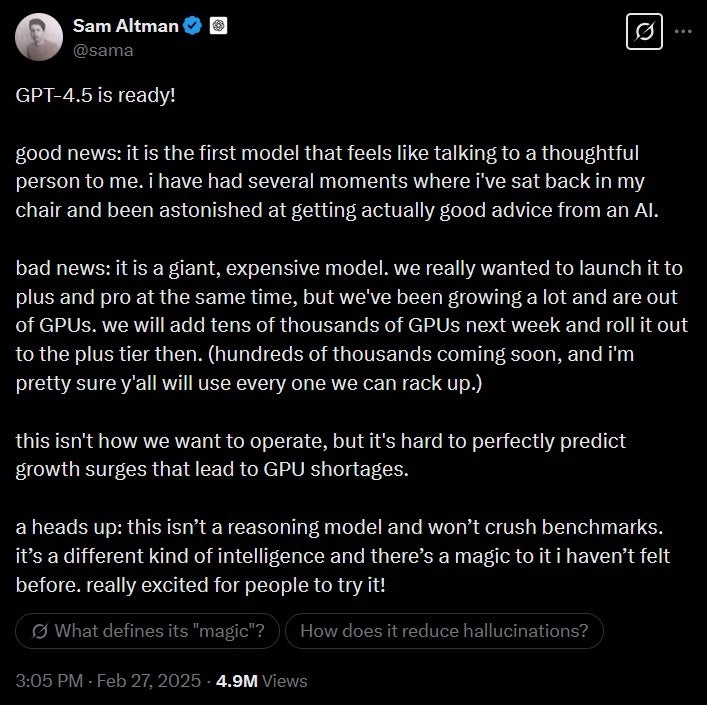
Sam Altman acknowledges the GPU shortage at OpenAI. | Image credit-X
During the discussion regarding GPT-4.5, Altman emphasized that this model does not aim to set new records in reasoning performance. Instead, he describes it as possessing a "different kind of intelligence" that he is excited for users to experience. Yet, he cautions that GPT-4.5 is an expensive venture, with costs mounting to $75 per million input tokens and $150 per million output tokens. In contrast, its predecessor, GPT-4o, offers a far lower cost at $2.50 per million input tokens and $10 per million output tokens. Tokens, which can be letters, words, or punctuation, are the basic units that Large Language Models (LLMs) use to process text.
The surge in NVIDIA's stock valuations, soaring nearly 1,748.96% in the past five years, largely correlates with the burgeoning demand for AI technologies and the company’s pivotal role as a supplier of essential GPU components.