Electric vehicle (EV) batteries are essential components, but their costs are significant. So, how much do these batteries actually cost? A recent infographic by Elements by Visual Capitalist provides a comprehensive breakdown of the cost structure for the average battery.
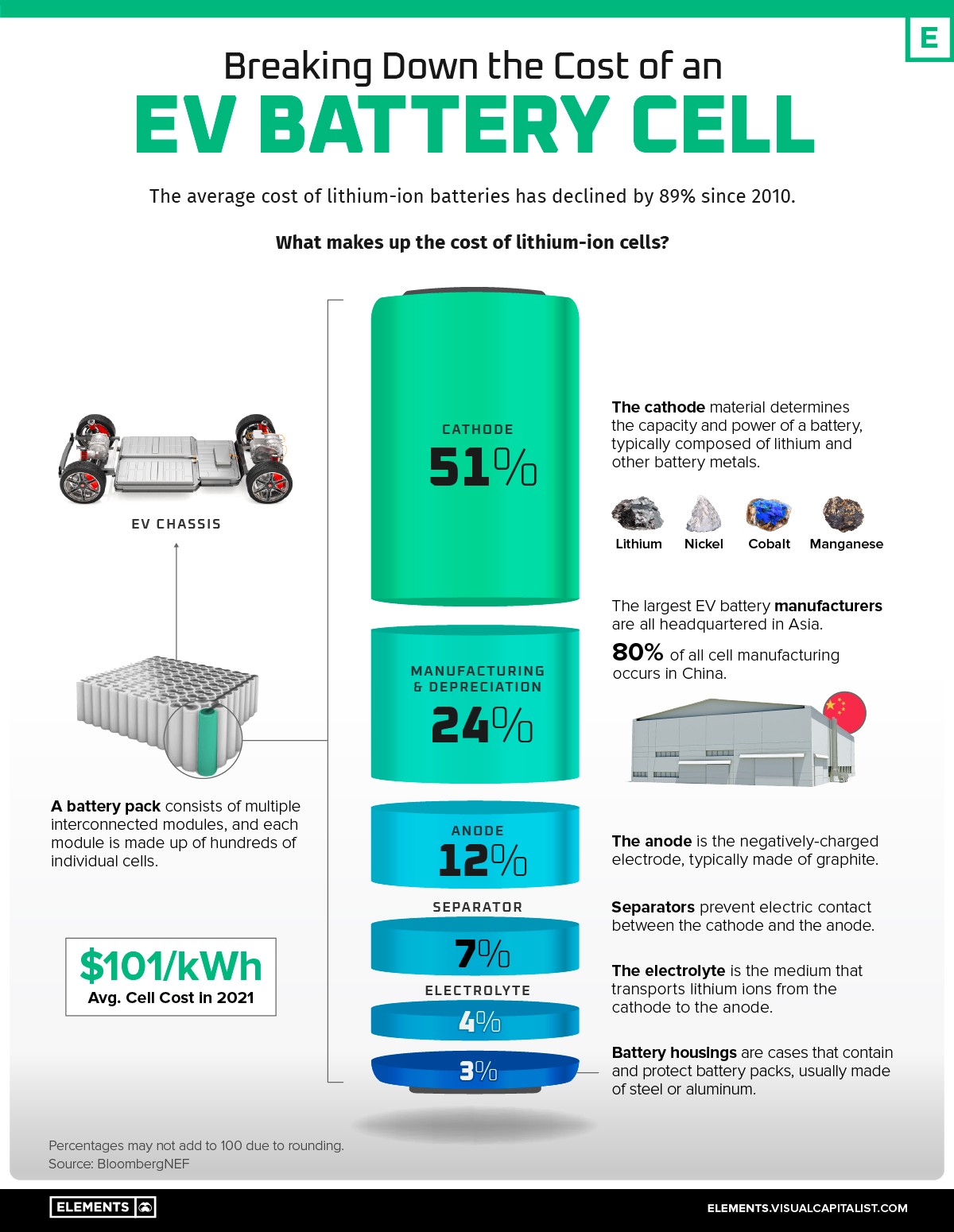
Last year, the average cost for battery cells was $101 per kWh. When considering the entire battery package, the cost rose to $132 per kWh. To estimate the battery cost for a specific EV, multiply its gross battery capacity (in kWh) by $132. While $132 per kWh might seem high, it's worth noting that the price was approximately $1,200 per kWh in 2010!
The infographic reveals that the most expensive component of the battery is the cathode, the positively charged electrode responsible for storing energy. During battery discharge, electrons and positively charged ions transfer from the anode to the cathode. The cathode's quality directly affects the battery's performance, range, and thermal safety, making it a crucial and costly element, accounting for about 40% of the total cell cost. Common cathode materials include lithium iron phosphate, lithium nickel manganese cobalt, and lithium nickel cobalt aluminum oxide.
The remaining components outside the cathode contribute to 49% of the cell's overall cost. Manufacturing plays a significant role, accounting for 24% of this cost. The anode, another critical battery component, represents 12% of the total cost. Typically, anodes in lithium-ion cells are constructed from less expensive natural or synthetic graphite, which is more affordable than the materials used in cathodes.
Source