While it's technically the latest, the Pixel 7a surely wouldn't be the only Pixel phone released in 2023. The Pixеl 8 series is about to make the second half of 2023 a lot more interesting and very busy for Google in the best way possible.
The Pixel 8 will certainly be a proper flagship phone in the truest sense of the term, with a new and improved chipset, possibly a new camera and camera software features, and possibly other potential improvements as well.
Meanwhile, the fresh and very new Pixel 7a is supposed to be Google's affordable phone for 2023, but its illogical pricing isn't making a strong case for it. Given the mere $100 difference in price with the Pixel 7 flagship, it's hard to justify why anyone would get that one instead of the mostly similar but somewhat more premium Pixel 7. But we digress.
There are actually rumors that the Pixel 7a could be the last member of the affordable Pixel series, and it would make sense for the Pixel 8 to sort of act as it spiritual successor, so it's quite interesting to see how things will transpire for Google's compact phones going forward.
Google Pixel 7a NOW $50 OFF
The new budget Google Pixel 7a champ can be yours directly from Amazon at a cool $50 discount during this Prime Day sale bonanza. The offer comes in the form of a gift card that can be used on products sold at Amazon.
If you get the new Pixel 7a over at Best Buy, the retailer will give you a discount in the form of a gift card you can use towards the purchase of a Pixel 7a case or anything else your soul desires from its extensive product catalog.
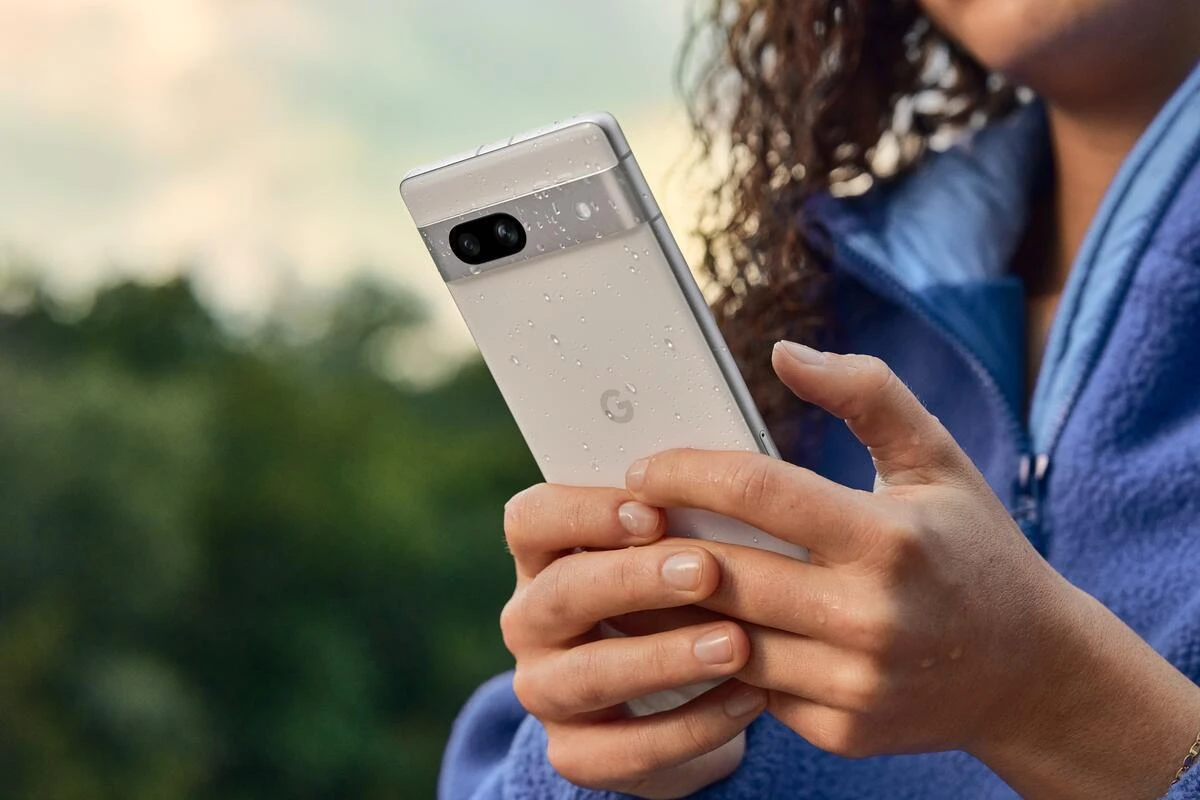
The Pixel 7a is unapologetically Pixel, with a familiar and friendly design language that's mostly in line with the Pixel 7 and Pixel 7 Pro. Gone is the black strip at the back of the phone, one of the signature device elements of the Pixel 6 series. Instead, the Pixel 7a has a so-called 3D Metal Visor in the same color as the side frame of the phone. As you might expect of an 'affordable' Pixel, the back side of the phone is made of plastic, while the frame of the phone is built from recycled aluminum.
It's too early to know if Google will change things up with the Pixel 8 as far as design goes. Frankly said, the existing design language works quite well for Google. Minor touch-ups here and there should probably be expected, but the general look and feel of the Pixel lineup will very likely remain live on the Pixel 8.
Pixel 7a
The Pixel 7a box comes neatly stuffed with a USB Type-C to USB Type-C cable in the box, a USB Type-A to USB Type-C adapter, the usual booklets, and a SIM ejector tool. No charger in the box of this one. This is the new normal.
In terms of display size and qualities, the Pixel 7a reiterates the Pixel 6a specs for the most part. It comes with a 6.1-inch FHD+ OLED display with relatively thick bezels, a punch-hole display, and a fingerprint scanner embedded into it. Notable is the bump to 90Hz refresh rate, which makes interface navigation noticeably smoother and more rewarding. The phone supports displaying HDR content.
The Pixel 8's display specs are still up in the air. We don't think Google will change the core display specs with the Pixel 8, so we'll assume that this one will come with a 6.3-inch OLED display with relatively maximum brightness (for a Pixel), and generally good color rendition.
The CIE 1931 xy color gamut chart represents the set(area)of colors that a display can reproduce,with the sRGB colorspace(the highlighted triangle)serving as reference.The chart also provides a visual representation of a display's color accuracy. The small squares across the boundaries of the triangle are the reference points for the various colors, while the small dots are the actual measurements. Ideally, each dot should be positioned on top of its respective square. The 'x:CIE31' and 'y:CIE31' values in the table below the chart indicate the position of each measurement on the chart. 'Y' shows the luminance (in nits) of each measured color, while 'Target Y' is the desired luminance level for that color. Finally, 'ΔE 2000' is the Delta E value of the measured color. Delta E values of below 2 are ideal.
The Color accuracy chart gives an idea of how close a display's measured colors are to their referential values. The first line holds the measured (actual) colors, while the second line holds the reference (target) colors. The closer the actual colors are to the target ones, the better.
The Grayscale accuracy chart shows whether a display has a correct white balance(balance between red,green and blue)across different levels of grey(from dark to bright).The closer the Actual colors are to the Target ones,the better.
The Pixel 7a comes with both a fingerprint scanner and photo-based face unlocking on board. The fingerprint sensor is fast and snappy, but you have to make good contact with the scanning area. You can also use the faster and more convenient Face Unlock, though it definitely isn't as secure as the fingerprint scanner.
We expect that the Pixel 8 will also come with both a fingerprint scanner and a 2D face unlocking solution.
Performance and Software
Will the generational leap from Tensor G2 to G3 be noteworthy?
Although it's perceived as "affordable", the Pixel 7a is actually powered by the flagship-grade Tensor G2 chipset, which is the same one that clicks and ticks inside the Pixel 7 and Pixel 7 Pro. It's fast enough as of today's standards, but it should be stressed once more that Google's line of custom Tensor chips were never about raw performance and high benchmark scores. Instead, it puts artificial intelligence as well as machine-learning at the forefront.
Pixel 7a
In my personal experience, performance on the Pixel 7a is more than decent. You will have to adjust your expectations accordingly, though, so don't expect any record-breaking fps numbers in 3D games. For my regular usage, the Pixel 7a is perfectly capable of handling everything I throw at it with ease. The smoother display definitely leaves the impression that the phone is much faster, which definitely helps with its perceived performance. There's just 128GB of storage available on board, so you will most likely have to rely on a cloud-based storage solution at some point.
The Pixel 8 will likely come with the next version of the Tensor chip. Most likely called the Tensor G3, is apparently codenamed "Zuma" but is still surrounded in secrecy. Rumors point out that this phone might come with a up to 12GB of LPDDR5X RAM, as well as a Samsung-made G5300 modem, but other than that, details are sparse.
In terms of software support, the Pixel 7a comes with Android 13 and will get three major software updates as well as five years of security support. This means that you should expect Android 14, Android 15, and Android 16 to grace the latest Pixel phone, and it will receive security patches until 2028. We expect a similar treatment for the Pixel 8, but as it will most likely arrive with Android 14 out of the box, we might expect to see Android 17 on the upcoming flagship.
Camera
The Pixel 7a gets new cameras, can we expect the same for the Pixel 8?
Pixel 7a
The Pixel 7a comes with a 64MP wide-angle camera utilizing the imaging prowess of a brand new camera sensor for the Pixel lineup - the Sony IMX787. At 64MP, it sounds like a very decent bump in resolution, but don't expect the Pixel 7a to output 64MP photos. Google uses quad-binning to combine four pixels into one, outputting 16MP photos. Said four pixels can let in way more light than a single one, thus improving the low-light capabilities of the phone.
The ultra wide-angle camera is also a new one. The Pixel 7a comes with the 13MP Sony IMX712 sensor, whereas most previous Pixel phones relied on the 12MP Sony IMX386 previously.
Chances are that both of these cameras could make it to the Pixel 8. Of course, it will be more than normal to expect a trove of improvements on deck that will make it a more capable camera phone. Most Pixels have traditionally been very strong camera contenders, on par with the Apples and Samsungs of the world, so it's normal to have high expectations of the Pixel 8.
Battery Life and Charging
With a 4,385mAh battery on board, the Pixel 7a strikes a very decent balance between battery capacity and overall size: it's quite compact but lasts a punch! As far as Pixels go, that's a fairly decent battery that can potentially last you more than a single day. And if you're not shy about enabling the Extreme Battery Saver mode here and there, the phone might even last you longer.
When it comes to the Pixel 8, early rumors claim we might finally see a battery capacity improvement: the upcoming small Pixel could get a battery with a rated capacity of 4,485mAh, an increase over the Pixel 7's battery rated capacity of 4,270mAh. Rated capacity is the regular output of a battery and is usually lower than the actual typical battery capacity. So, it's safe to assume that the Pixel 8 will have a larger battery.
The Pixel 7a doesn't come with a charger in the box and the Pixel will likely not feature the essential wall adapter either. The Pixel 7a supports up to 18W wired charging and debuting on an affordable Pixel 7.5W wireless charging. That's quite slow compared to most flagships supporting up to 15W, but even having wireless charging on the Pixel 7a is sort of a win.
Specs Comparison
So far we don't yet have the detailed specs about the Pixel 8, but we will be updating this table as soon as we learn more.
Specs
Pixel 7a
Pixel 8
Dimensions
6.00 x 2.87 x 0.35 inches (152.4 x 72.9 x 9 mm)
-
Weight
6.81 oz (193.0 g)
-
Screen
6.1-inch, 90Hz
-
Processor
Google Tensor G2
Google Tensor G3
RAM, Storage and Price
8GB, 128GB, $499
-
Cameras
Wide: 64MP IMX787 OIS Ultra-wide: 13MP IMX712
-
Battery Size
4,385mAh
4,485mAh
Charging Speeds
18W wired, 7.5W wireless
24W wired
Summary and Final Verdict
Although slightly more expensive than its predecessor, the Pixel 7a is a very decent offering pairing almost flagship specs at a mid-range price. Surely, for $100 more you can get a Pixel 7, but don't be so quick to shoot down the Pixel 7a just yet. It's a sensible phone that focuses on the basics and will easily last you a lot if you give it the chance.
Meanwhile, we are still not sure what direction Google's taking with the Pixel 8. Provided that things go the way we expect, we might see a slight redesign, improved performance and camera image quality, as well as even smarter software nice-to-haves. We will know as soon as the phone goes official. Or, as history would have it, leak profusely in the coming months.
So, should you wait for the Pixel 8 or go with the Pixel 7a? If you need a phone right now and you've decided that it simply has to be a Google one, then you should probably choose wisely between the Pixel 7 and the Pixel 7a. Waiting for the Pixel 8 would only make sense if you can wait and are curious to see what Big G might be cooking.