Intro
If you are looking for a powerful, no-compromise phone that is not too big, Apple's iPhone 15 Pro and Samsung's Galaxy S23 are clearly the first two names that come to mind.
Which one should you go for? Obviously, one is an iPhone and the other an Android phone, so that's the biggest difference, but feature-wise they are also very distinct.
The iPhone 15 Pro has the more advanced and newer A17 Pro chip, the world's first 3nm chip, and it has a number of quality of life improvements with an Action Button and fancy new titanium frame.
It also finally makes the switch to a USB-C port, the same one that Android phones use, so both the Galaxy and iPhone are now on the same port.
The Galaxy S23, on the other hand, has passed the test of time: it is small, light weight, well built and it also features a powerful triple camera system. So, they are indeed both powerful, but... which one should you actually go for?
iPhone 15 Pro vs Galaxy S23 differences:
- iPhone more expensive
- iPhone has faster chip
- Both have 6.1" screen sizes
- Galaxy weighs less
- iOS on iPhone vs Android on Galaxy
- iPhone has more zoom options (new 28mm and 35mm)
- iPhone has longer battery life
- Similar charging speeds
Table of Contents:
Read more:
Design and Size
Both are similarly compact
Starting with the looks, both are 6.1-inch phones and both have roughly the same physical footprint.
The build quality is premium of course, but while the Galaxy uses an aluminum frame, the iPhone goes for fancy titanium. Titanium has the advantage of being better at resisting all kinds of damage, and it has a brushed finish, resisting fingerprint smudges better.
One sore point of previous iPhones was they were heavy for their size, and titanium also helps as it weighs less than the stainless steel used before.
Both phones come with an IP68 water and dust protection rating, just as you'd expect on a 2023 flagship.
Apple makes one change to the buttons with a new Action Button. This new button is programmable so you can set it to your own preference. By default it still turns on the Mute function, but you can set it to start the camera, or launch any app via the Shortcuts. The Galaxy does not have such a button and we do wish it had, it's a nice little convenience.
In terms of ports, both use the same USB-C port. We love having a USB-C port on an iPhone and not have to deal with the Lightning cables, it just makes life easier as all other electronics use this port.
Finally, in terms of colors, both have a slightly muted palette of "pro" colors.
Display Differences
The Galaxy and the iPhone come with a 6.1-inch screen size and both use Samsung-made OLED panels, so they are pretty darn similar. And yes, both screens are flat.
The iPhone is just slightly sharper with its 1179p resolution compared to the 1080p on the Galaxy, but this difference is so tiny you probably won't even notice.
Both screens also have dynamic 120Hz refresh rate, so scrolling and swiping looks buttery smooth, but the iPhone is a bit more advanced as it goes all the way down to just 1Hz for static content, while the Galaxy S23 can only go as low as 48Hz, which is not as power efficient. Subtle difference again, but worth noting.
One thing the iPhone improves is the bezel size around the screen which is now much thinner for a more modern look.
In terms of biometrics, the iPhone goes with the Face ID system, while the Galaxy relies mostly on the ultrasonic in-screen fingerprint reader. You do have a face recognition system on the Galaxy, but it is not as secure as the 3D based on on the iPhone.
Performance and Software
A17 Pro on iPhone 15 Pro beats the Snapdragon 8 Gen 2 in the Galaxy
The Apple A17 Pro chip on the iPhone 15 Pro is the world's first mobile chip built using TSMC's 3nm technology.
This cutting edge process allows packing a lot more transistors and performance in the same die size, but the main benefit might actually be the big gains in power efficiency.
Samsung's Galaxy S23, on the other hand, is powered by one of the best Qualcomm chip in years, the Snapdragon 8 Gen 2. It's manufactured using TSMC's 4nm process, and it is also an excellent chip, but it is a beat slower than the A17 Pro.
Both phones come with 8GB of RAM, so no difference there.
And then you have the software where the iPhone and the Galaxy could not differ more. The iPhone has the latest iOS 17, while the Galaxy runs on Android 13 with Samsung's One UI 5.1 (soon to be updated to Android 14 and One UI 6.0).
Apple has added a lot of new features to iOS in the past few years and with iOS 17 it brings big changes to the Phone, Messages and FaceTime apps. Oh, and autocorrect on iPhones is also finally getting better!
The Phone app in iOS 17 supports Contact Posters which is essentially a picture you set for yourself which other iPhones see full-screen when you call them. You also have NameDrop, a new way to exchange contacts between iPhones by just bringing them next to each other. In the Messages app, you now have stickers and live stickers.
Other novelties in iOS 17 include Standby Mode, turning your iPhone into a mini home hub when it’s charging, then come the new interactive widgets, mood tracking in the Health app, a brand new journaling app, and more.
But despite all that, iOS 17 still lacks proper split-screen multitasking for example, which you do have on the Galaxy.
Samsung has also increased the software support on its devices and you now get 4 years of major updates guaranteed, but Apple goes a step further with at least 5 years of major updates, and don't forget that iOS updates arrive much faster than Android updates on Samsung phones, which can take up to half a year after the release.
Camera
A very close battle, but Apple has the upper hand
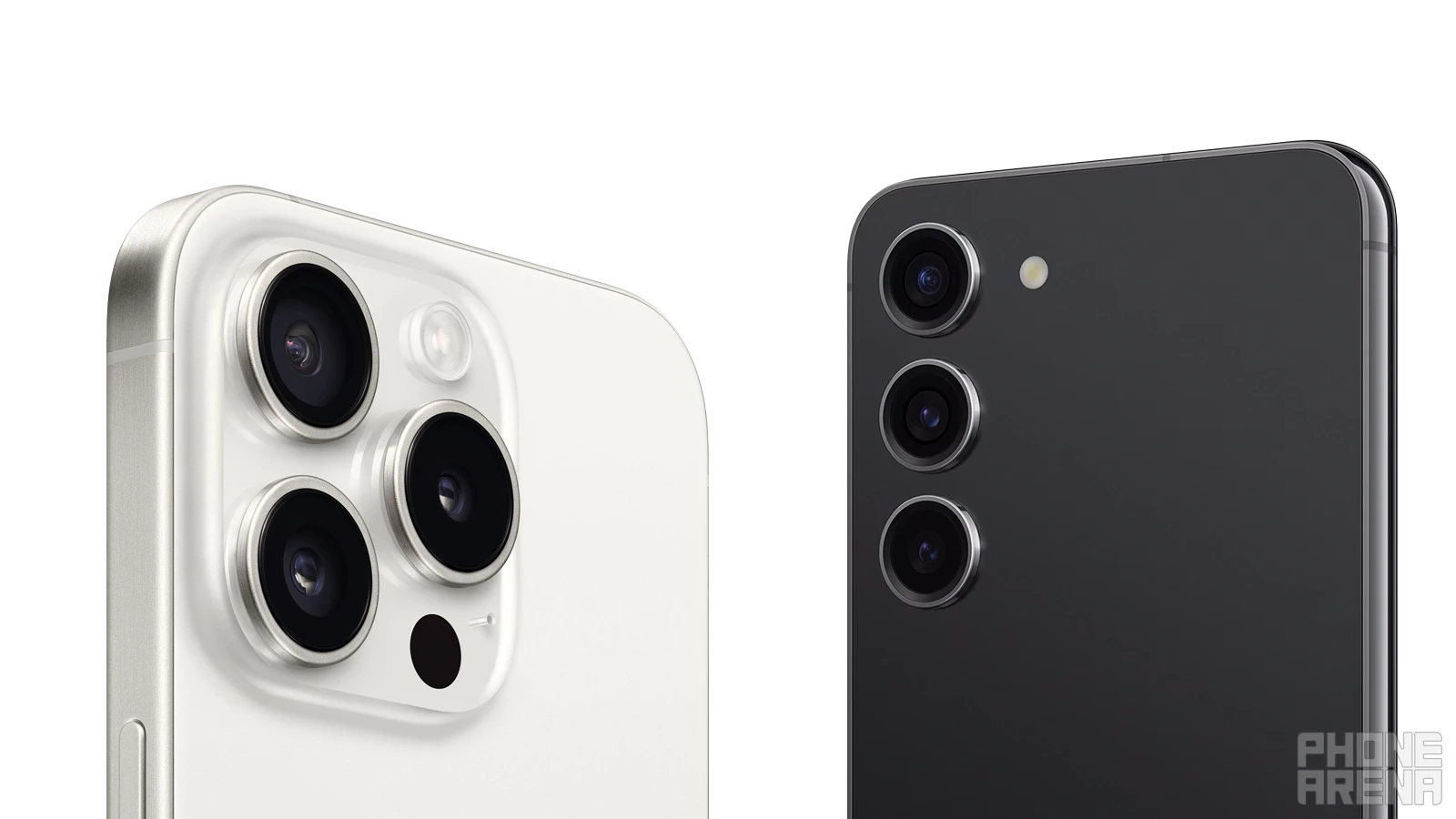
Both phones come with a triple camera system, and it's oh so similar.
You have a 48MP main camera on the iPhone and a 50MP main shooter on the Galaxy, then you have 12MP ultra-wide camera on both, and finally, you have a 3X zoom shooter again on both. Both phones can also use the ultra-wide camera to take macro shots.
The iPhone, however, gets a number of very important tweaks and tricks.
Thanks to sensor cropping, you get lossless image quality at 2X (48mm), 1.5X (35mm) and 1.2X (28mm), which is like getting three new lenses for free. These are great focal lengths and very useful too.
And of course, image quality between the two will still be different. Samsung is known for its vibrant, larger than life color science, which some like and others find excessive, while the iPhone has less extreme colors, but has its own issue with extreme over-sharpening to fix.
Zoom quality has traditionally been one area where Samsung has done a better job than Apple, so it's interesting to compare that directly, and we will be doing so over the coming weeks.
For video quality, the Galaxy has really stepped it up in one area: video stabilization, which is now very good on the Galaxy S23.
The iPhone, however, is still the better camera for video overall, with cleaner footage and more resolved detail, and now it also addresses the dreadful lens flare on previous models with a new lens coating.
Both phones also support Cinematic Mode / Portrait Video which allows you to blur the background, an effect you typically get with a proper stand-alone camera, but again the iPhone is better at actually doing that effect.
Audio Quality and Haptics
Both phones come with a dual speaker system consisting of a main, bottom-firing speaker and a secondary one in the earpiece.
The Galaxy S23 was a big upgrade over its predecessors, and we expect the audio quality to be roughly similar on these two phones.
In terms of haptics, the Galaxy does a good job, but we still prefer the incredibly Taptic Engine which provides a bit tighter vibration alerts and feels more refined.
Battery Life and Charging
iPhone has the upper hand
The Galaxy S23 comes with a 3,900 mAh battery, while the iPhone 15 Pro features a 3,274 mAh battery sizes.
Apple explicitly says that battery life on the iPhone 15 Pro is exactly the same as on the previous 14 Pro generation, so that means that the iPhone lasts longer than the Galaxy.
What we also know is that Apple's iOS platform is just better at power efficiency and practice has shown that the iPhone typically has longer real-world battery life than the Galaxy.
We will update this section with our independent battery tests once we get a hold of the iPhone 15 Pro.
On the charging front, we are so glad to have the same USB-C port on both these phones, that is just so convenient. No charger in the box, as we've already mentioned, but you probably have one laying around already.
Both phones support wireless charging as well, with the iPhone here a bit faster and more convenient thanks to 15W MagSafe (Galaxy supports 10W wireless Qi charging).
Specs Comparison
Below, you can check out the difference in specs between these two:
| iPhone 15 Pro | Samsung Galaxy S23 | |
|---|---|---|
| Size, weight | 146.6 x 70.6 x 8.25 mm 188 grams | 146.3 x 70.9 x 7.6mm 168 grams |
| Screen | 6.1" OLED 120Hz ProMotion | 6.1" OLED 120Hz |
| Processor | A17 Pro 3nm | Snapdragon 8 Gen 2 4nm |
| RAM, Storage | 8/128GB 8/256GB 8/512GB 8/1TB LPDDR5 | 8/128GB 8/256GB 8/512GB - LPDDR5X |
| Cameras | 48MP main 12MP ultra 12MP 3X zoom 12MP front | 50MP main 12MP ultra 10MP 3X zoom 12MP front |
| Battery | 3274 mAh | 3900 mAh |
| Charging | USB-C 23W wired MagSafe | USB-C 25W wired 10W wireless |
Don't forget that we have an in-depth iPhone 15 Pro vs Samsung Galaxy S23 specs comparison here where you can learn a lot more about individual characteristics like band support, camera details and more.
Summary and Final Verdict
At the end of the day, these are two of your best (if not the best) options if you are looking for a compact flagship phone.
The iPhone 15 Pro has a number of improvements, but it remains the iOS ecosystem that lures people in with its familiarity, iMessage, support for Apple Watch, AirPods, AirDrop and so on. In terms of pure hardware improvements, the iPhone 15 Pro certainly clears the bar with its industry-leading chip, improved cameras and finally, a USB-C port.
What is your reason to pick one over the other?