Intro
The iPhone 15 Plus is the second iteration of the resurrected "Plus" model officially unveiled at this year's Wonderlust 2023 event. It's Apple's take on the big-screen iPhone without the big price tag. What has changed since the reintroduction of the Plus with the iPhone 14 Plus? How do these two iPhone Plus generations stack up against each other? Read on to find out! This is our detailed comparison between the upcoming iPhone 15 Plus and its parent, the iPhone 14 Plus.iPhone 15 Plus vs iPhone 14 Plus in a nutshell:
- A16 chip vs A15 chip
- Same 6GB RAM
- Same screen size
- Same storage options
- Upgraded 48MP main camera
- Dynamic Island
- New color options
- Same battery size
- Same price
Table of Contents:
Read more:
Read more:
Design and Size
Same physical size, different colors
There are no major changes between these two when it comes to design. The big ones, obviously, are the pill-shaped camera cutout and Dynamic Island software feature, both these features have come to the iPhone 15 Plus, retiring the notch forever.
The other design change that's been in the pipeline for quite some time now and is sort of out of Apple's hands is the switch from Lightning to USB-C. The new standard will make things a bit easer when it comes to cables but the faster transfer and charging speeds are reserved for the Pro models.
iPhone 15 Plus Colors:
- Black
- Green
- Pink
- Blue
- Yellow
iPhone 14 Plus Colors:
- Midnight
- Starlight
- (PRODUCT)RED
- Purple
- Blue
- Yellow
Display Differences
New pill-shaped cutout
There are no major changes in display size and resolution from the iPhone 14 Plus to the new model. The iPhone 15 Plus comes equipped with the same 6.7-inch OLED display clocked at the traditional 60 Hz refresh rate we know from the previous model. Both phones sport the same resolution - 2796x1290 pixels, resulting in a pixel density of 460 PPI (pixels per inch).
Both phones seem to have virtually identical display with one huge difference - the notch! Or rather the lack of it in the iPhone 15 Plus. The phone borrows the pill-shaped cutout from the Pro models of last year, along with the Dynamic Island functionality. There's a slight bump in brightness as well, the iPhone 15 Plus can go up to 1,600 nits peak HDR, and up to 2,000 nits peak outdoor brightness.
Performance
A step up but still a step behind
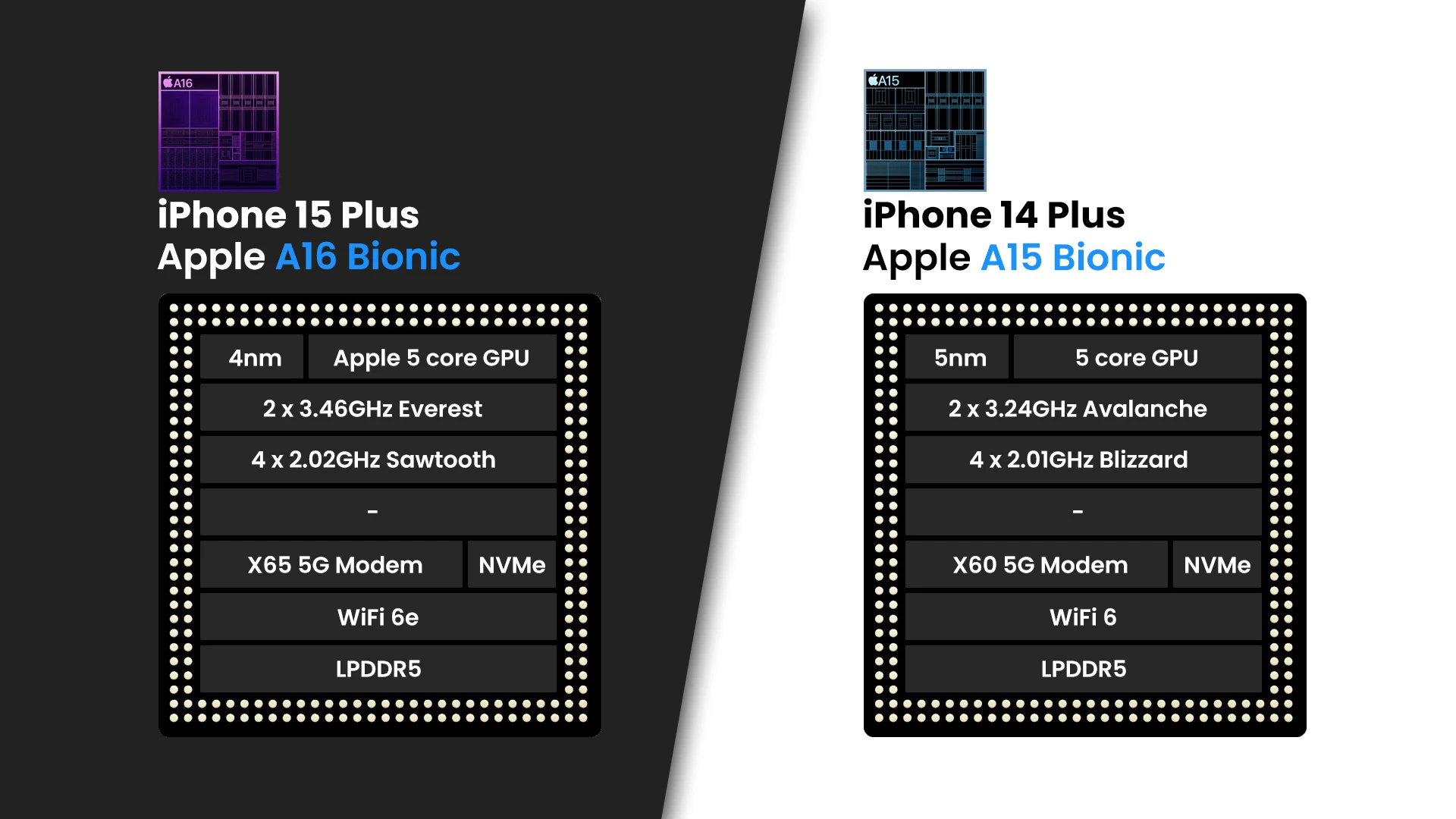
The iPhone 15 Plus is equipped with the A16 chipset from last year's Pro and Pro Max models, which means it technically has more processing power than the iPhone 14 Plus. The traditional tic-tock cycle continues, and this year's model ramps up the performance and takes it to the aforementioned Pro and Pro Max levels from last year.
The switch to the A16 brings some efficiency gains for the iPhone 15 Plus over its predecessor, as this chipset is built using a 4nm manufacturing process compared to the 5nm of the iPhone 14 Plus and the A15. We need to further test this, of course, but get ready for better 5G speeds and connectivity thanks to the X65 5G modem, and all in all, performance-wise, some similar numbers as the 13 Pro and 13 Pro Max with the new iPhone 15 Plus.
The switch to the A16 brings some efficiency gains for the iPhone 15 Plus over its predecessor, as this chipset is built using a 4nm manufacturing process compared to the 5nm of the iPhone 14 Plus and the A15. We need to further test this, of course, but get ready for better 5G speeds and connectivity thanks to the X65 5G modem, and all in all, performance-wise, some similar numbers as the 13 Pro and 13 Pro Max with the new iPhone 15 Plus.
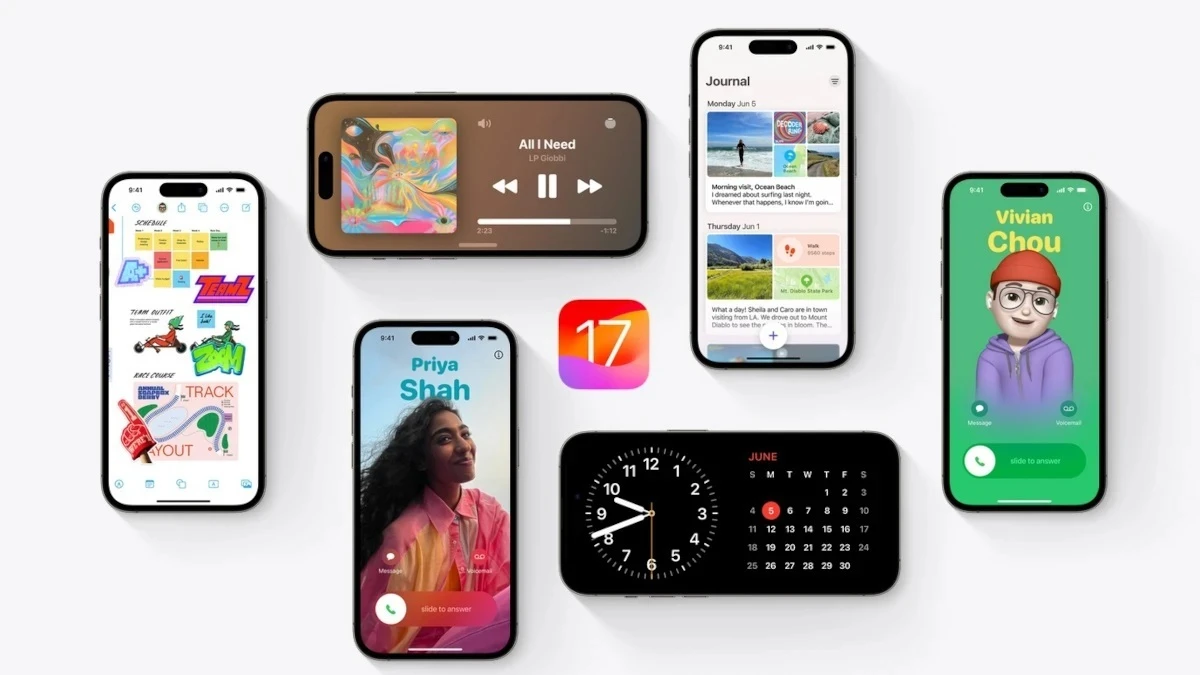
Both the iPhone 14 Plus and the iPhone 15 Plus sport the same 6GB of LPDDR5 RAM, and the storage options remain the same between both models. When it comes to software, both phones run on iOS 17 (available for download from September 18). The iOS 17 developer beta is already up for download, so you can try it, of you wish. Apple showcased some of the new features during the annual WWDC forum, and you can also check them in detail in our dedicated iOS 17 article.
Emergency SOS via satellite is coming to the iPhone 15 Plus, along with a new feature relying on satellite communication - roadside assistance by satellite. As the name suggests, it uses satellite to send a message to AAA Roadside Assistance and get you out of trouble if there's no network signal present.
Camera
Same old, but with more pixels
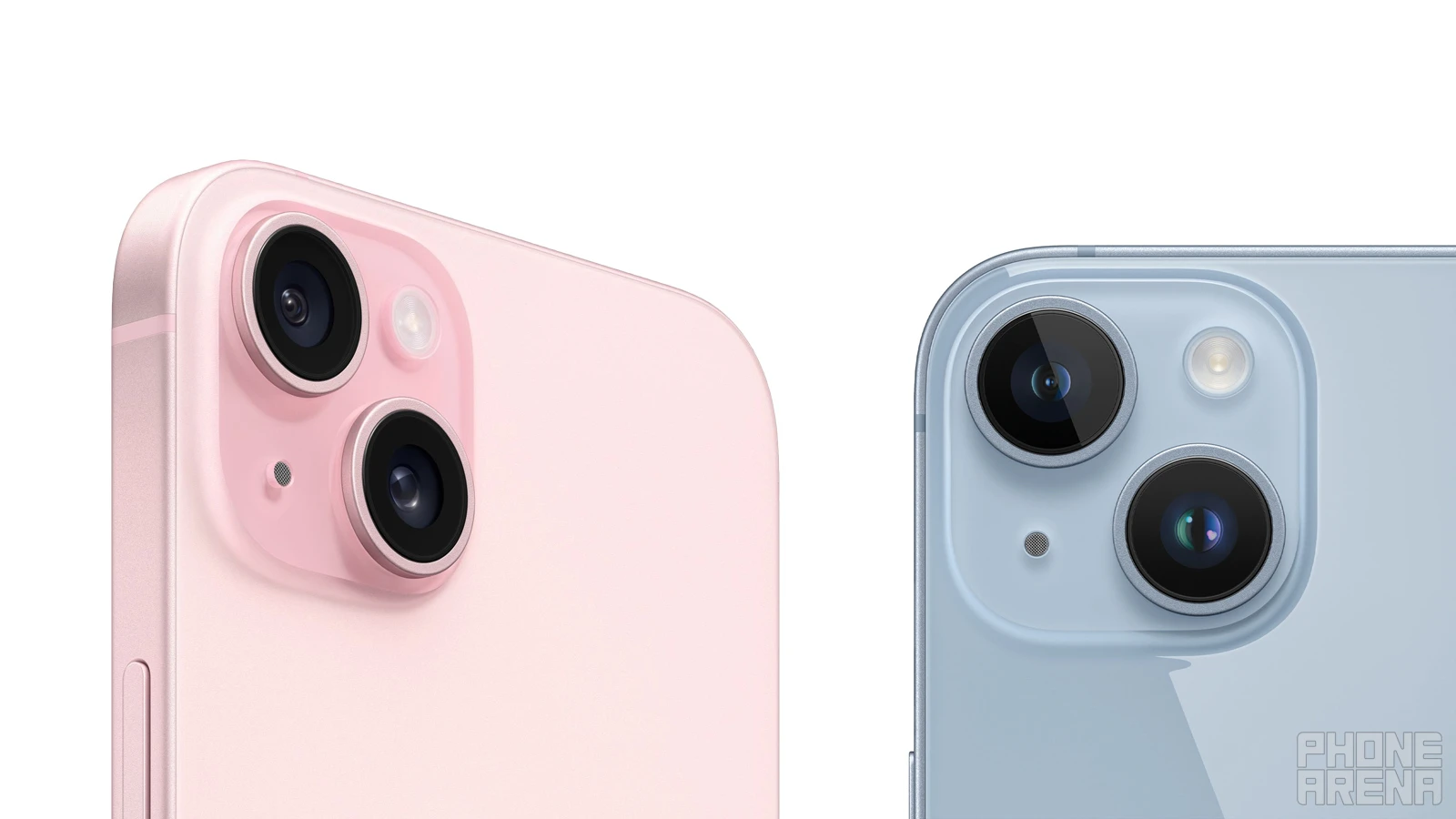
The main sensor from the iPhone 14 Pro and Pro Max has been transferred to the iPhone 15 and iPhone 15 Plus. Therefore, the iPhone 15 Plus has a clear pixel count advantages over its predecessor. The 14 Plus uses a 12 megapixel main camera with sensor-shift optical image stabilization, while the iPhone 15 Plus now has a 48-megapixel main sensor.
There some magic going on with the resulting images, they default at 24MP, apparently taking 12MP pixel-binned shots and adding additional detail to make them 24MP. The bigger sensors and resolution also allows for something that Apple calls Optical-quality 2x telephoto. In practice it's a 2x crop from the main 48MP sensor, resulting in a 12MP image with twice the focal length, or in layman's terms 2x. The new iPhone 15 Plus features improved image processing algorithms, especially in the Portrait department.
The ultrawide camera has been carried over from the previous generation, so there's no difference between the two phones in that regard. We're looking at a 12-megapixel, 120-degree field of view camera on both the iPhone 14 Plus and the iPhone 15 Plus. The selfie camera is identical between the two models, namely the 12-megapixel shooter on the iPhone 14 Plus.
There some magic going on with the resulting images, they default at 24MP, apparently taking 12MP pixel-binned shots and adding additional detail to make them 24MP. The bigger sensors and resolution also allows for something that Apple calls Optical-quality 2x telephoto. In practice it's a 2x crop from the main 48MP sensor, resulting in a 12MP image with twice the focal length, or in layman's terms 2x. The new iPhone 15 Plus features improved image processing algorithms, especially in the Portrait department.
The ultrawide camera has been carried over from the previous generation, so there's no difference between the two phones in that regard. We're looking at a 12-megapixel, 120-degree field of view camera on both the iPhone 14 Plus and the iPhone 15 Plus. The selfie camera is identical between the two models, namely the 12-megapixel shooter on the iPhone 14 Plus.
Audio Quality and Haptics
Again, no big changes in audio quality between the iPhone 14 Plus and the iPhone 15 Plus. We haven't tear down the iPhone 15 Plus yet, but we're pretty sure it uses the same loudspeaker, earpiece, and haptic motor from the previous model. Which isn't a bad thing.
We already know that the big size of the 14 Plus gives enough space for a decent speaker, and the results are very pleasing - defined, with a good bass, and almost no distortion at louder volumes. The same stereo speaker sits inside the iPhone 15 Plus, alongside the tight and responsive haptic motor.
Battery Life and Charging
No change in battery size but efficiency has been improved
The iPhone 15 Plus most likely retains the same big 4,325mAh battery (Apple doesn't list capacities on its site but judging from the usage hours, it looks like the same cell), and we already saw great results from the iPhone 14 Plus' battery tests. Given the fact that the iPhone 15 Plus comes equipped with the A16 chip, built on a more efficient 4nm manufacturing process, but keep the same 60Hz refresh rate on the display, we expect even better battery life out of the new model (stay tuned for our in-depth battery tests).
Now, the charging situation remains more or less the same, despite the newly acquired USB-C port on the iPhone 15 Plus. The iPhone 14 Plus supports up to 20W wired via the Lightning port, and that's enough to charge 50% of the battery in 30 minutes. Apple cites the same charging speeds for the iPhone 15 Plus with 20W charger, so sadly no change in charging speed (or transfer speeds for that matter, USB 3.0 speeds are reserved for the Pro models).
Now, the charging situation remains more or less the same, despite the newly acquired USB-C port on the iPhone 15 Plus. The iPhone 14 Plus supports up to 20W wired via the Lightning port, and that's enough to charge 50% of the battery in 30 minutes. Apple cites the same charging speeds for the iPhone 15 Plus with 20W charger, so sadly no change in charging speed (or transfer speeds for that matter, USB 3.0 speeds are reserved for the Pro models).
Specs
We have summarized all of the major specifications highlights of the two models right below:
| iPhone 15 Plus | iPhone 14 Plus | |
|---|---|---|
| Size, weight | 160.8 x 77.8 x 7.8 mm, 201 grams | 160.8 x 78.1 x 7.8 mm, 203 grams |
| Screen | 6.7" OLED 60Hz | 6.7" OLED 60Hz |
| Processor | A16 Bionic 4nm | A15 Bionic 5nm |
| RAM, Storage | 6/128GB 6/256GB 6/512GB - LPDDR5 | 6/128GB 6/256GB 6/512GB - LPDDR5 |
| Cameras | 48MP main 12MP ultra - 12MP front | 12MP main 12MP ultra - 12MP front |
| Battery | 4325 mAh* | 4325 mAh |
| Charging | USB-C 20W wired MagSafe | Lightning 20W wired MagSafe |
Summary and Final Verdict
The iPhone 15 Plus is an evolution, rather than revolution. Clearly, it adds some nice features over its predecessor, such as the pill-shaped cutout for the front camera, accompanied by the Dynamic Island feature, a bigger 48MP main camera, and a better chipset.
Other than that, we're looking at two very similar phones, with nearly identical size, battery, display, hardware and software capabilities. The price of the iPhone 15 Plus is also identical to the price at launch of its predecessor, starting at $899. Should you upgrade to the 15 Plus if you already have the iPhone 14 Plus? Probably not. But if you're coming from an older iPhone, and like big screens, solid battery life, and the convenience of a long support cycle, the iPhone 15 Plus is definitely a viable option.